
The US said it has strong evidence that China has deployed anti-ship missiles, surface-to-air missile systems and electronic jammers to contested features in the Spratly Islands region of the South China Sea.

The agreement would divert China's attention and keep them busy in the Pacific theatre, probably resulting in a reduction in threat perception in our area of interest in the Indian Ocean, notes Commodore Venugopal Menon (retd).

The Indian Navy has just one aircraft carrier. The INS Vikramaditya carries just 26 unreliable MiG-29 fighters and 10 helicopters -- an insufficient capability to battle a serious foe.

'With the recent challenging of the notion of the Indian Ocean Region being India's strategic backyard, China is gradually upping the ante in the maritime realm around India.'

Confronting a slowdown in growth, China says it will only increase its defence budget by 7.6% this year, against the anticipated rise of between 20% and 30%. 'It is difficult to explain the reduction in the Chinese defence budget,' says Claude Arpi. 'Is there a hidden budget? Possibly!'

When questioned about the absence of any mention of the Indian Navy's role in the operation, Hua said China's ministry of defence should be approached for details.

'The Chinese navy is large and expanding both in numbers and capability by the day.' 'India too must take measures to safeguard its own interests, now and in the future.'

'Whether it's investments in Kashmir, building naval facilities, or selling top-of-the-range military equipment, Pakistan could well benefit more under Xi's watch.' 'Do Chinese concerns about the 'Islamisation' of Pakistan give it pause about how quickly to move forward with security and economic projects? At the moment the indication is quite the opposite: China is doubling down on its support to Pakistan, partly because of its fears about where the country is headed.'

'New Delhi showed itself willing -- at least for a period -- to tolerate the risk of conflict and to withstand Beijing's implicit and explicit threats.' 'But it also continued to try to cut some kind of deal with China to reduce tensions.'

What was the need for Xi Jinping, general secretary of the Chinese Communist Party, President of the People's Republic of China and Chairman, Central Military Commission, to don the new role of Commander in-Chief? Does this mean that the most powerful Chinese leader since Mao faces numerous threats from within the Communist Party?

As China begins rejuvenation of its military power, there is an urgent need for transformation of the Indian military, says Lieutenant General Anil Chait (retd).

However, Denmark said it is difficult to conclude on the real intention behind this.

'India's military posture has become significantly stronger than China's on the 3,500-kilometre Line of Actual Control.' 'This is enhancing confrontation between the two sides,' points out Ajai Shukla.

China will be the nuclear threat of most concern to New Delhi for at least another decade, the latest report by the Arms Control Association says.

'The Chinese thought India would back off. 'They did not expect such a firm Indian response to their expansionist manoeuvre.'

'We are not going to be threatened by China neither are we going to threaten China.'
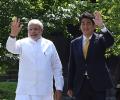
Although the India-Japan relationship has its own driving forces in terms of robust economic ties and shared values, China is the elephant in the room in the strategic parleys between the two countries, says Rup Narayan Das.

China's Navy wants to join hands with India to maintain security of the Indian Ocean

'China's growing nexus with Pakistan and the two countries' unresolved territorial disputes with India continue to pose a formidable national security threat to India,' says Brigadier Gurmeet Kanwal (retd).
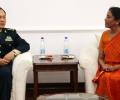
'In the case of an India-Pakistan confrontation, the Chinese may undertake more than just posturing, thereby constraining us from deploying adequate forces for decisive results,' warns Brigadier S K Chatterji (retd).
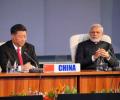
'Modi's finest political legacy ought to be a border settlement with Beijing,' asserts Ambassador M K Bhadrakumar.

India and China on Wednesday signed in all nine agreements, including the Border Defence Cooperation Agreement and one on strengthening cooperation on trans-border rivers, after restricted and delegation-level talks that lasted over two hours as Prime Minister Manmohan Singh and Premier Li Keqiang met for the second time this year for talks which the Indian leader described as "fruitful and productive".

'The intrusion in Chumar, during and beyond the Chinese president's visit, is unprecedented and has qualitatively changed the tone of the India-China relationship,' says Jayadeva Ranade, a member of the National Security Advisory Board.
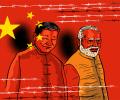
'As China rises and India grows to reclaim their earlier positions on the world stage as two of the largest economies and most important countries, there will indeed be some contention between these two powers.' 'There will also be plenty of space and room for cooperation amongst the two of us.' 'As our economic size increases to match the fact that we are the two most populous nations on earth, it will be all the more important for us to keep the interests of our peoples as well as those of the rest of the world in mind.' 'We shall have to grow together rather than as separate and disparate entities,' points out Ambassador Gautam Bambawale -- who served as India's ambassador to China -- in the 7th annual lecture of the Indian Association of Foreign Affairs Correspondents on March 1, 2019.

'How can Kashmir be demilitarised if the terrorist threat remains and Pakistan continues to incite elements in Kashmir to keep the internal situation unstable?' asks former foreign secretary Kanwal Sibal.

'Under the present Defence Procurement Procedure, it would have been a nightmare, and a long, long one at that, to build 108 Rafales in India. Modi realised this and took the wise decision, though it is a definitive setback for his Make in India scheme.'

With Beijing having had a profound rethink on India's admission as a full member of the Shanghai Cooperation Organisation, the tectonic plates of the geopolitics of a massive swathe of the planet stretching from the Asia-Pacific to West Asia are dramatically shifting. That grating noise in the Central Asian steppes will be heard far and wide -- as far as North America, says Ambassador M K Bhadrakumar.

'If we play our cards right, we may even benefit from the competition between the US and China as seen from increased investment from each of these countries into India.' 'The size of our market gives us an important lever of power which we shall have to play adroitly and intelligently,' points out Ambassador Gautam Bambawale -- who served as India's envoy to China -- in the Professor V M Dandekar Memorial Lecture 2019, delivered on March 8, 2019 in Pune.
 © 2026 Rediff.com - Advertise with us - Disclaimer - Privacy Policy - Sitemap - Feedback - About us - Terms of use - Grievances